Mobile app security for healthcare and medical device apps
Protect patient health data at rest, in transit and in use on devices neither the provider nor the patient can fully secure. A medical history cannot be reset once exposed; harden the app that carries it.
Health data cannot be reset once it leaks
Digital health has moved medical records, appointment systems and clinician communication onto consumer phones. A compromised password is replaced in seconds; a leaked medical history is permanent, and every interaction now moves protected health information onto a device that is unmanaged, often shared and frequently running an outdated operating system.
SecIron secures the application itself rather than the device: assessment finds the vulnerabilities, hardening closes them inside the binary, and monitoring shows your team every attempt to reach patient data in the field.

What attackers do to mHealth apps
Healthcare applications are attacked through the app code, the runtime environment and the device. Understanding these threats is the first step toward a patient service people can trust.
Reverse engineering
Decompiling the app to find where records are stored, how they are encrypted, and the endpoints and keys that reach the clinical back-end.
Cloned provider apps
A repackaged copy that impersonates your hospital, clinic or insurer to harvest patient identity and health data.
Runtime interception
Hooking frameworks on rooted or jailbroken devices intercepting data as a clinician or patient reads it.
Overlays and screen capture
Malware that draws a fake screen over the real one or records the display while a patient views results or enters credentials.
Man-in-the-middle attacks
Intercepting traffic between the app and clinical systems on shared or hostile networks.
Regulatory exposure
HIPAA, GDPR, PDPA and national health data protection requirements that demand demonstrable controls and an incident record.
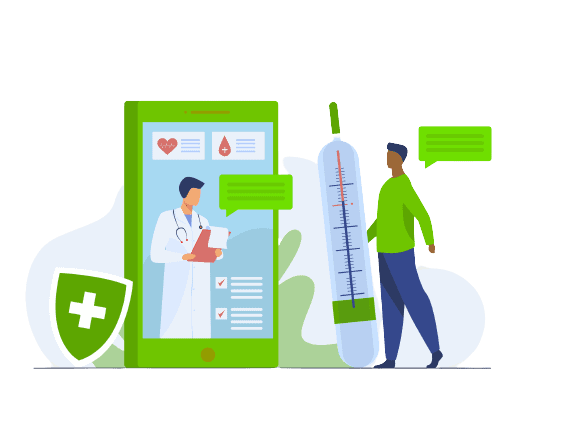
Protection built for digital patient services
Patients book appointments, read test results and message clinicians from their phones. Encrypted local storage keeps patient records unreadable at rest, and root and jailbreak detection ensures the app refuses to decrypt and display them where its protections could be stripped.
Anti-repackaging stops attackers cloning your app to impersonate a healthcare provider. Anti-hooking stops runtime frameworks intercepting data as a clinician or patient reads it. Real-time monitoring records every attempt.
Safeguard patients’ digital journeys
Secure your mHealth applications against data breaches, man-in-the-middle attacks and reverse engineering, and provide a high level of assurance that your app delivers value to patients, physicians and other users through robust digital security.
Request a consultationBenefits for healthcare providers and medtech
Keep users comfortable with the security of their data, because a lack of trust makes patients go inactive, uninstall or never download at all.
Safeguard patients’ digital journeys
Secure mHealth applications against data breaches, man-in-the-middle attacks and reverse engineering, with assurance that your app delivers value to patients and physicians.
Build mHealth apps with dedicated security
Whether your app is in development or already deployed, protection is applied through a hassle-free, codeless process, with real-time RASP that monitors, detects and responds autonomously.
Meet local requirements and standards
New legislation on cybersecurity and data protection, from HIPAA and GDPR to regional health data rules, requires mobile health applications to meet strict standards. Build an app secured for today and for future requirements.
Increase patient trust
Keep users comfortable with the security of their data. Trust keeps current patients active and brings prospective users to the app.
Audit-ready evidence
A timestamped incident log of detected threats, affected devices and responses taken, ready for a privacy officer, auditor or regulator.
Codeless, CI/CD-ready
Protection applied to the compiled build in your pipeline, so hardening ships at your release speed rather than on a separate project timeline.

Three solutions for the whole lifecycle

Assess before release
Automated vulnerability assessment against OWASP MASVS, with remediation guidance for every finding.
Explore IronSCAN →
Harden the binary
Multi-layer, codeless hardening: obfuscation, encryption, anti-tampering and RASP, applied to the compiled app.
Explore IronWALL →
Monitor in the field
Real-time detection and response across every session, with an audit-ready incident record.
Explore IronSKY →Healthcare mobile app security, asked and answered
Why is mobile app security different for healthcare?
Because the data cannot be reset. A leaked password is replaced in seconds; a leaked medical history is permanent. And the data is read on devices neither the provider nor the patient can fully secure, so the app itself has to carry the protection.
How does hardening protect patient records on the device?
Encrypted local storage keeps records unreadable at rest, root and jailbreak detection stops the app decrypting them where its protections could be stripped, and anti-hooking stops runtime frameworks intercepting data as it is displayed.
Does it help with HIPAA, GDPR and regional health data rules?
It delivers the application-layer controls and the evidence: encryption at rest and in transit, tamper and runtime protection, and a timestamped incident log you can show a privacy officer or regulator.
What about medical device companion apps?
The same protection applies. The app that controls or reads from a connected device holds pairing secrets and control logic; hardening keeps those unreadable and anti-tampering stops a modified app issuing unauthorised commands.
Does it require changes to our source code?
No. Protection is applied to the compiled APK, AAB or IPA as a step in your build pipeline, with no SDK to integrate and nothing for your developers or vendor to rewrite.
Can we deploy it privately?
Yes. SecIron runs as SaaS or on-premise, with role-based access and full log and report generation either way, so builds and threat telemetry never leave your perimeter if policy requires it.
Can telemedicine apps be protected without affecting video quality?
Yes. Protection operates on the application and its runtime environment rather than intercepting media streams, so video and audio performance are unaffected.
Our app was built by an external agency. Can it still be protected?
Yes. Protection is applied to the compiled application, so no access to source code and no involvement from the original developer is required, which helps where the development relationship has ended or the original team is unavailable.
Resources for healthcare security teams
 BlogData protection: an ultimate guideRead the article
 BlogHow cybercriminals bypass facial recognition and what you can doRead the article
 BlogWhy data encryption is essential to secure digital ecosystemsRead the article
 WhitepaperMan in the Middle (MiTM) attack: everything you need to knowRead the guide

 Public servicesIndustryPublic servicesSee the industryInternet of ThingsIndustryInternet of ThingsSee the industry
Ready to secure your mHealth app?
From deployment to security and beyond, SecIron takes you from visibility to action. Bring us your app and we will show you what an attacker sees, then what they see once it is protected.
End-to-end mobile application security. Assess, harden and monitor Android and iOS apps with codeless integration.
