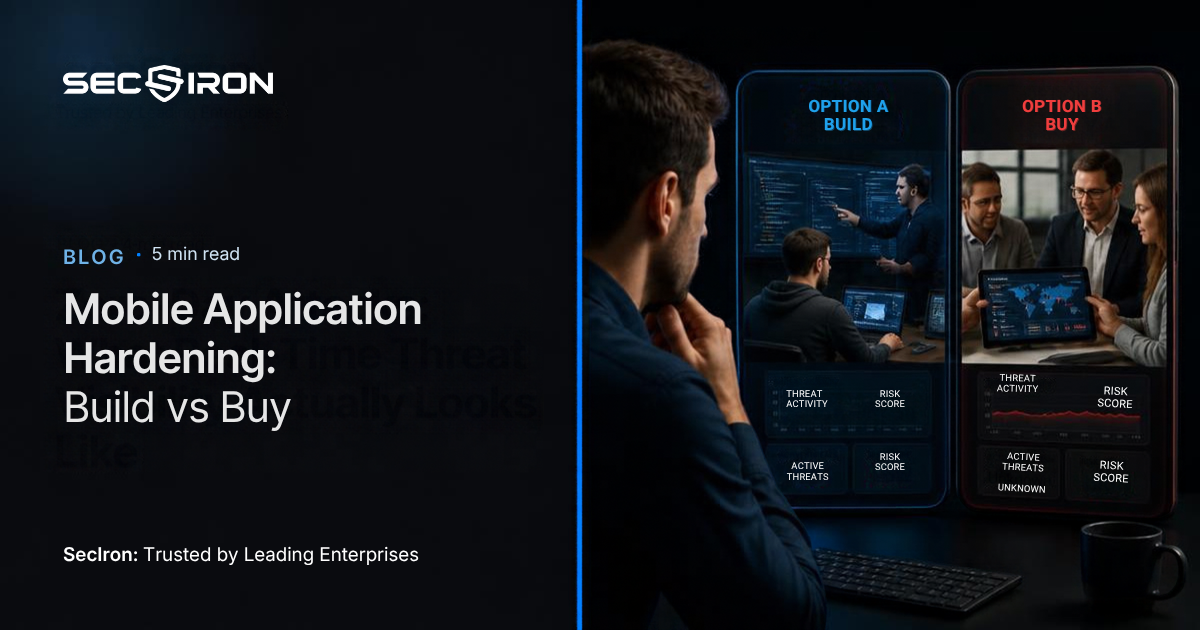
Mobile Application Hardening: Build vs Buy
Every organisation that takes mobile application hardening seriously eventually asks whether to build it. The question is reasonable. The controls are documented, the techniques are public, and a competent mobile engineer can implement root detection in an afternoon.
This is an honest comparison, including the cases where building is the right answer.
What Building Mobile Application Hardening Actually Means
The afternoon estimate is accurate for the first control and misleading for the programme. A production hardening capability covers code protection and obfuscation, string and resource encryption, integrity verification, anti-repackaging, root and jailbreak detection, hooking and injection detection, debugger and emulator detection, virtualisation detection, overlay and screen capture protection, secure input, and a policy engine so responses can differ by threat.
Then it has to be maintained.
The Recurring Costs Teams Underestimate
OS releases
Two major platform versions a year, each capable of breaking detection or changing what is observable.
Bypass research
Public tooling to defeat common detections is updated continuously by people who do it full time.
False positives
Device diversity means a check that works in testing blocks real customers in one market.
Key-person risk
This work concentrates in one or two engineers, and it leaves when they do.
Portfolio scaling
Implemented per app, per platform, per team, and it drifts between them.
Evidence production
Regulators want dated records per build, which means building reporting as well as detection.
The Structural Problem With In-House Hardening
An in-house implementation has one weakness that no amount of engineering quality fixes: it is unique to you, and it is only ever tested by you.
A commercial mobile application hardening product is attacked continuously across thousands of applications. When a new bypass technique appears against any customer, the fix reaches all of them. Your in-house version is tested by whoever happens to target you, and you find out it failed by discovering the consequences.
The inverse argument is also fair. Uniqueness has value, because your custom detection is not in any public bypass toolkit. That advantage lasts precisely until someone decides your app is worth an afternoon.
When Building Is Right
You have a standing mobile security team. Not one interested engineer. A team, with cover, whose job this is.
Your requirements are genuinely unusual. Bespoke hardware, an unusual runtime, or detection tied to proprietary logic that no product models.
You have one app and no roadmap pressure. Scaling and drift are what make in-house implementations decay, and both are absent here.
Regulation forbids third-party involvement entirely. Rare, and usually answered by on-premise deployment rather than by building.
When Buying Mobile Application Hardening Is Right
You have a deadline. Compliance dates do not move for a build plan.
You have a portfolio. Consistent protection across many apps is where in-house effort multiplies and commercial effort does not.
Your engineers are fully committed to product. Which is nearly everyone, and the reason most in-house hardening quietly stops being maintained.
You need evidence, not just controls. Building detection is achievable. Building dated, exportable, portfolio-wide audit records is a second project.
The Hybrid Most Teams Land On
Keep the platform-native basics you already have, including ProGuard or R8 on Android and correct Keychain and Keystore use. Buy the layers that need continuous research: obfuscation and encryption, integrity enforcement, runtime detection and reporting.
That split puts your engineers on work only they can do, and puts the continuously eroding controls with someone whose full-time job is maintaining them.
Where SecIron Fits
 The layers that decay, maintained for you
IronWall provides code protection and obfuscation, three-layer encryption, anti-tampering, anti-repackaging and runtime detection, applied to the compiled binary with no SDK and no source code changes. Because there is nothing in your repository, there is nothing for your team to maintain through OS releases.
On-premise deployment is available where third-party handling of builds is restricted, which answers most of the objection that leads teams toward building. Explore IronWall
Related: What Is Mobile App Hardening? A Complete Guide for Security Teams
Conclusion
The mobile application hardening build-versus-buy question is usually framed as a comparison of capability, and it is really a comparison of sustained attention. Almost any competent team can build hardening. Very few can keep maintaining it through four OS releases while shipping a product roadmap.
Ask what the control will look like in two years, not what it costs to implement this quarter.
Ready to launch a secure app?
If you are weighing this internally, send us your app and compare a protected build against what your team estimates. It is a faster answer than a business case.
Recent Posts

Mobile Application Hardening: Build vs Buy
October 18, 2026
Certificate Pinning: Why It Fails and What to Pair It With
October 15, 2026
Employee Highlight: Muhammad Iqbal
October 13, 2026